
Two Free Hours and Nothing You Actually Wanted to Do
Sep 10, 2026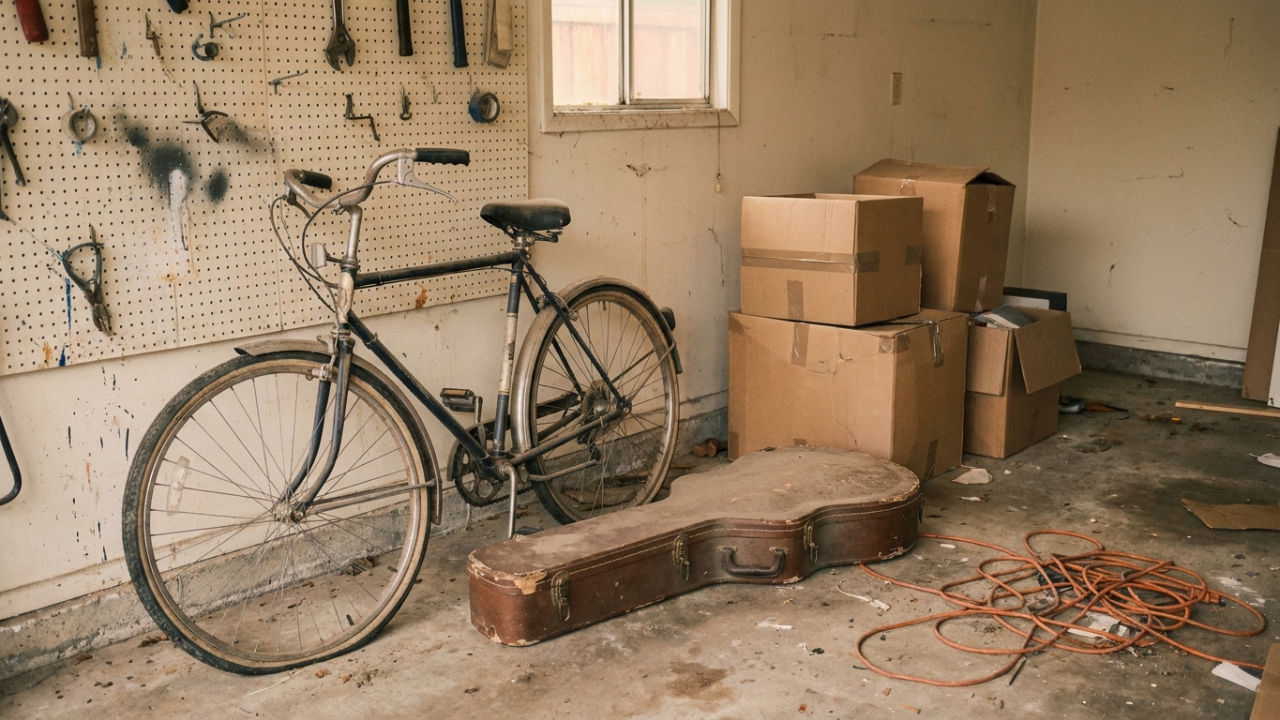
There's something in your garage you bought on purpose.
A bike. A guitar case. Clubs, a kayak rack, a box of paints you paid real money for. You didn't end up with it by accident — at some point you looked at your own life, decided something was missing, and spent money to fix it. It has been sitting there long enough now that you've stopped seeing it.
Then last Saturday happened. Somebody took the kids, or nobody needed anything, and the house went quiet at two in the afternoon with two clean hours in front of you.
You sat down. You picked up your phone. At four you stood up feeling slightly worse than you had at two, and you couldn't have said out loud what you'd done with the time.
That's the friction. It isn't that you have no free time. It's that you got some and it evaporated.
What's actually happening
You've been treating free time like a container that fills itself. It doesn't. Left alone, it fills with the one activity that costs nothing to begin.
Because play has an entry fee. Small, but real. You have to change clothes. Find the thing. Drive somewhere. Be visibly bad at something for twenty minutes before it gets fun. That's a tiny bill — and a tired adult at two on a Saturday will not pay a tiny bill. So the hours go to the only option with no bill attached, and the option with no bill attached gives nothing back.
Always Play Hard is the commitment people skim fastest, and the word they skim past is hard. It isn't there to demand intensity. It's there because play requires something of you, and the moment it requires nothing, it isn't play anymore. It's just a screen keeping you company.
There's a quieter version of this too. Most adults have filed joy under reward — the thing that comes after the work is finished. The work is never finished. So joy becomes the item that structurally never arrives, and you don't notice its absence as sadness. You notice it as flatness. As a Saturday you can't account for.
Why the usual fix doesn't hold
The first fix everyone tries is to schedule it. Put fun on the calendar like a dentist appointment and treat it as non-negotiable.
That collapses within a month, and not because you lack discipline. An appointment with yourself, involving no one else, with no cost to canceling, is the very first thing that moves when something real lands on the same afternoon. Fun defended by nothing loses to everything.
The second fix is to borrow someone else's. A friend runs, and he comes back from it lit up in a way you envy, so you buy the shoes. Six weeks later you own shoes. You conclude you're not a person who follows through.
You are. You just took up another man's play, and someone else's play is only work with worse pay.
Zechariah, painting a picture of a city finally made well, includes a detail that's easy to read past: "And the streets of the city shall be full of boys and girls playing in its streets" (Zechariah 8:5). Not full of commerce. Not full of soldiers. Full of kids messing around outside, because that's what a place looks like when it's safe and whole and nobody's bracing. Play isn't the prize handed out after a life gets healthy. It's the evidence that it is.
Which is where the two halves of the Always Advantage pull apart. Always is the part that doesn't flex: you go do it on the Saturday you don't feel like it, the same way you'd go to work on a Tuesday you didn't feel like it. You have to be genuinely disciplined about delight, which sounds absurd right up until you count the Saturdays you've lost. Style is the part that has to flex: what counts as play is not transferable between two people. For one of you, play is a body in motion with a score at the end. For another, it's four hours alone with a hard problem nobody is paying you to solve. Both are play. Neither one can be prescribed to the other person without turning into a chore.
The practice
Get the entry fee under two minutes. Not more motivation — less friction. The guitar out of the case and on a stand in the room you sit in. The bike aired up on Thursday, not Saturday. Shoes by the door. You're not going to win an argument with yourself at two in the afternoon, so remove the argument. If you're wired to plan: do the setup at the end of the week, when planning is fun for you and the doing is still theoretical. If you're wired to react: keep exactly one thing ready, not five. Five options is a decision, and a decision is a delay.
Find the category, not the activity. Think about what you did at ten years old, before anything you did was being graded. You're not looking for the specific activity — you are not going back to Little League. You're looking for the shape of it. Were you building things, competing, exploring, performing, organizing a world? The adult version looks nothing like the childhood one. The category almost never changes. If nothing comes to mind: ask someone who knew you then. They remember, and their answer will surprise you less than you expect.
Attach it to a person or a time nobody can move. This is what fixes the calendar problem. Play that only you know about gets canceled silently. If you're social by wiring: find one other person and make it a standing thing, because you'll show up for them long after you'd have quit on yourself. If you're solitary by wiring: don't force a group — anchor it to something immovable instead, the hour before the house wakes up, the Thursday night that's already blocked. Solitary play is not antisocial. It's just yours.
Decide, on purpose, whether it gets a scoreboard. Some people's play dies without stakes; the game is the point and the score is what makes it a game. Other people's play dies the second it gets measured — the run becomes a metric, the painting becomes an output, and something that was free becomes one more thing you can fail at. You know which one you are. Set it up accordingly, and stop apologizing for it either way.
The close
You are not going to drift into delight. Nobody has. It costs about four minutes and somebody has to pay it on purpose, and there's no one else in the garage.
Always Show Up As You.
SUBSCRIBE FOR WEEKLY LIFE LESSONS
Practical, faith-grounded lessons on building a life that holds up under pressure. One email a week, short enough to read before your coffee cools.
We hate SPAM. We will never sell your information, for any reason.