The Ride Was Great Until You Checked Your Average Pace
Oct 20, 2026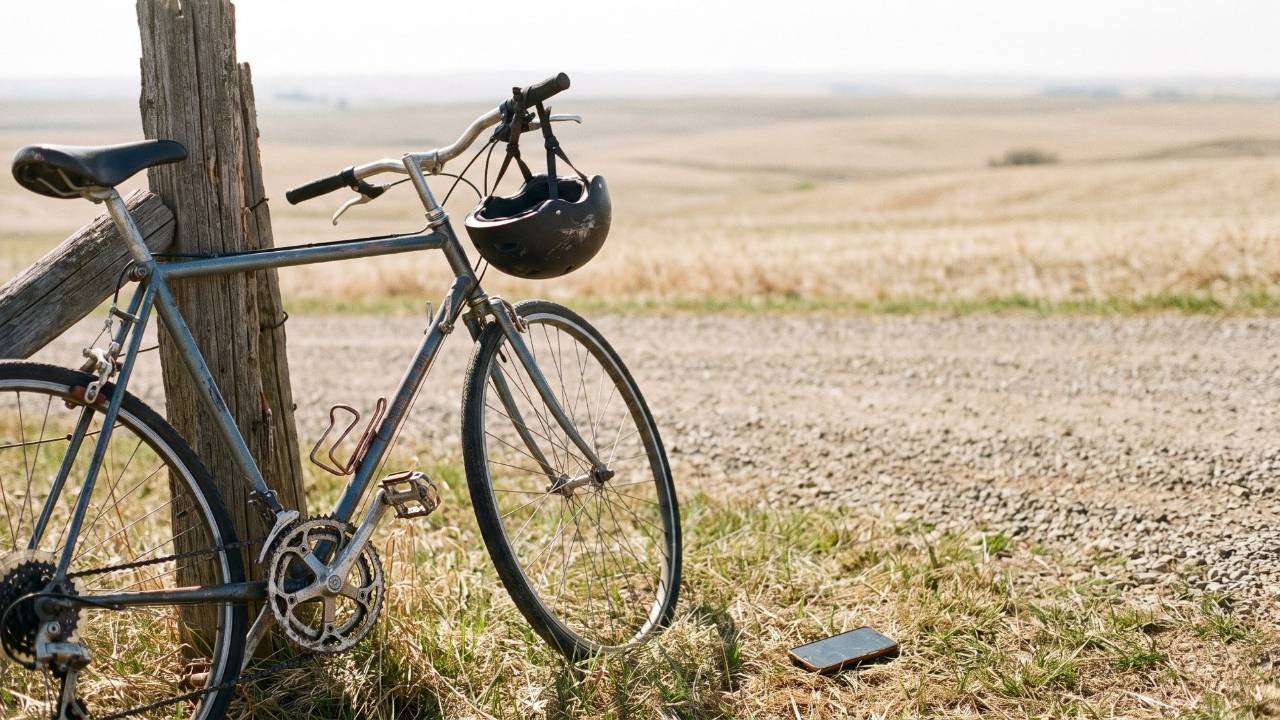
For forty minutes the ride was just a ride. Legs, air, the long downhill where you stopped pedaling for no reason except that coasting felt good. You were not thinking about anything, which is rarer than you'd admit.
Then, at the driveway, the buzz. The app has your summary ready. Average pace down 0.4 from last Saturday. A little orange arrow, pointing the wrong way.
And just like that, the last forty minutes get re-graded. The ride you were on — the one that felt like being ten years old — quietly becomes a workout you underperformed.
What that actually is
There's a counterfeit of Always Play Hard, and it isn't sitting on the couch. You're not guilty of skipping play. You have the bike, the clubs, the running shoes, the Saturday block on the calendar. By every outside measure, you play.
The counterfeit is play that's been conscripted. Somewhere along the way, the achievement reflex — the one that serves you well from Monday to Friday — followed you into the one part of the week that was supposed to be free of it. Now the hobby has a dashboard. The hike has a photo obligation. The golf has a handicap trajectory you're behind on. The thing you do for joy has KPIs, and you are once again a person with numbers to hit.
It still looks exactly like playing hard. That's what makes it hard to catch. But there's a simple tell: play produces nothing, and that's the point of it. The counterfeit can't tolerate producing nothing. It needs the streak, the stat, the post, the progress — some artifact that converts the afternoon into evidence. When the artifact is bad, the afternoon was bad. You've built a job and scheduled it on Saturday.
Why the usual fix doesn't take
The standard advice is the advice you already took: get a hobby, make time for fun, protect your weekends. You did all three. The problem was never the absence of play. It's that you brought the scoreboard with you, and no amount of scheduling fixes what you carry into the schedule.
Ecclesiastes puts play in a category our dashboards can't process: "that everyone should eat and drink and take pleasure in all his toil — this is God's gift to man" (Ecclesiastes 3:13). A gift. Not a reward for hitting pace, not a recovery protocol to optimize, not content. You cannot earn a gift and you cannot improve one — you can only receive it or refuse it. The counterfeit is a refusal that looks like enthusiasm: it takes the gift, ties a metric to it, and hands it back as one more thing to be good at.
This is where Always and Style separate.
Always is the fixed part: joy gets a real, protected place in your week, entered whole-heartedly — not the leftover scraps after everything measurable is done. That doesn't flex.
Style is what delight actually looks like on you — and the counterfeit's favorite move is choosing your hobbies for you. It picks the ones that measure well and photograph well, and skips the ones you'd do off the record. The honest question isn't "what are my hobbies?" It's "what would I still do if no one — including my own apps — ever knew?"
The practice
Play off the record once this week. One session of your usual thing with nothing running. No tracker, no photos, no telling anyone after. Notice what it feels like when the outing can't become evidence. If you're wired for data: don't delete the app, just leave the phone home once — you can survive one unlogged ride. If you're wired social: go with the friend who never posts, and match them.
Ask the ten-year-old question. What made hours disappear when you were ten? Building, drawing, water, ball on pavement, getting lost outside? Do the grown-up version of that this week — the un-upgraded, un-optimized version. If you're wired to make things: make something useless on purpose. If you're wired to move: move somewhere with no route to complete.
Retire one metric. Pick the number that most often sets your mood after playing — pace, score, streak, likes — and take it off the table for a month. If numbers genuinely deepen the fun for you: keep them, but check them weekly instead of live, so they inform the play without narrating it. If the number decides whether you enjoyed yourself: that's not measurement anymore, it's management. Cut it first.
Be gladly bad at something. Do one activity you have no talent for and no plan to improve at. Mediocrity you're not fixing is the fastest way to find out whether you can still play at all. If you're wired competitive: pick something with no ladder — skipping stones, throwing a frisbee, cooking something ridiculous. If you're wired careful: let the result be visibly imperfect and give it away anyway.
The close
If it stopped counting, would you still go? Go like the answer is yes.
Always Show Up As You.
SUBSCRIBE FOR WEEKLY LIFE LESSONS
Practical, faith-grounded lessons on building a life that holds up under pressure. One email a week, short enough to read before your coffee cools.
We hate SPAM. We will never sell your information, for any reason.